The Demo That Talks Back: Why B2B Buyers Now Expect an AI Agent Inside Your Product Experience

KEY TAKEAWAYS
- 83% of the B2B buying decision happens before a rep is ever involved.
- Static demos fail buyers at the exact moment their intent is highest.
- 67% of buyers prefer rep-free but 69% still need a human to validate.
- Interactive demos now shape the buyer’s journey before sales enters the picture.
- An AI agent bridges the gap between self-serve and human validation.
- Buyers who get answers mid-demo convert at significantly higher rates.
Your demo can show the product. It cannot answer a question.
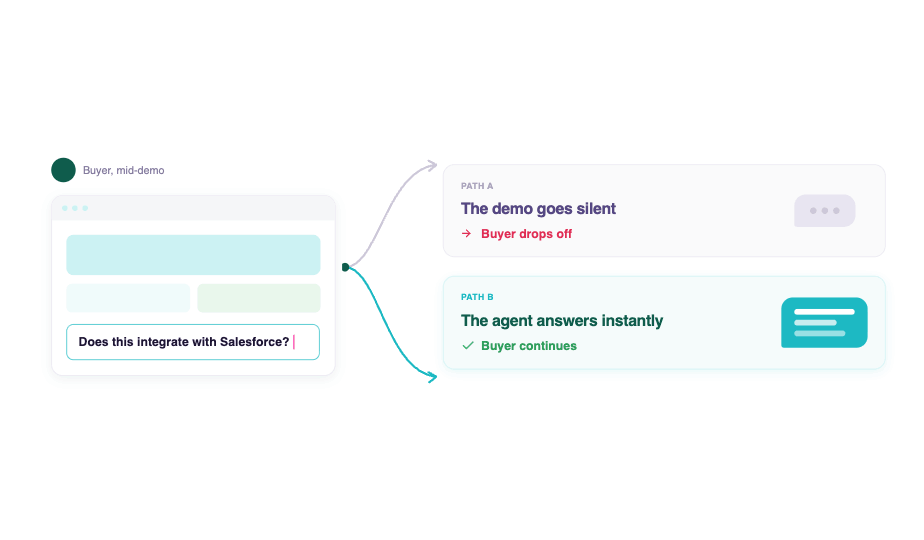
That gap between what a buyer sees and what they need to know is where most high-intent buying journeys end. A buyer arrives at your demo. They click through three or four screens. They see something that looks relevant. They have a question: does this integrate with our CRM? What does it cost for 200 seats? How is this different from what we are already using?
The demo cannot answer. So the buyer does one of three things. They fill out a “contact us” form and wait two days for a rep to follow up. They go back to the AI tool they were using to research vendors and ask there instead — where your competitor may well show up in the answer. Or they simply leave, carrying a half-formed impression and no next step.
According to Gartner’s 2026 buyer research, 83% of the B2B buying decision happens before a prospect engages with a sales rep. And 67% of buyers actively prefer a rep-free experience. The buyer journey has moved self-serve. The problem is that most demos have not moved with it.
The Question Your Demo Cannot Answer
Interactive demos have fundamentally changed how buyers evaluate software. Before the modern interactive demo existed, the only way to see a product was to book a call. The demo gave buyers something they had never had: the ability to experience the product on their own time, at their own pace, before anyone asked them about budget or timeline.
That was a significant step forward. But it created a new problem. The interactive demo is brilliant at showing. It is built to present a linear or semi-linear product experience, optimized for the use cases the seller decided to highlight. What it cannot do is respond. A buyer who watches a five-step demo on your analytics workflow and then wants to know how the data exports into Excel hits a wall. The demo was not built to answer that. It was built to show what the seller wanted to show.
This matters because the moment a buyer has a question is the moment their intent is highest. They have seen enough to be interested. They want to go deeper. They want to validate. And the experience gives them no way to do that without picking up a phone or sending an email — which is precisely the friction most B2B buyers are actively trying to avoid.
The cost of this wall is measurable. Prospects bounce. The richest signal in the funnel — what the buyer actually wanted to know — never gets captured. The rep follows up blind, without knowing what the buyer cared about or where they stopped.
The Self-Serve Buyer and the Validation Gap
Here is the tension at the center of modern B2B buying. Buyers want to self-educate. They are doing it constantly — through AI tools, through review sites, through product websites and demo experiences. They are forming opinions and shortlists before a rep ever enters the picture. According to Gartner 2026, 70% of buyers want a fully digital, self-service buying experience.
And yet: 69% of buyers still rely on a human to validate what AI tells them before making a final decision.
Those two numbers define the shape of the problem. Buyers are not trying to avoid expertise. They are trying to avoid the parts of the sales process that feel like process rather than help — the scheduling, the waiting, the pitch. They still want answers to hard questions. They still want someone to tell them whether a specific integration works, whether the pricing makes sense for their team size, whether the security posture is strong enough for their compliance requirements.
They just want that conversation to happen on their timeline, not the rep’s. They want it in the moment they are curious, not two days later when a rep finally follows up.
The AI model they use to research vendors can answer generic questions about your category. It cannot answer specific questions about your product, your pricing, or your use cases: not accurately, not reliably, and not in a way grounded in your own sales knowledge. That is the gap between what buyers want and what the self-serve experience currently provides.
What New Technologies in Demo Platforms for B2B Marketing Are Changing This
The way B2B buyers research software has fundamentally shifted over the past 24 months. Buyers now begin their journey with AI tools by asking general questions about categories, getting vendor lists, comparing capabilities at a high level. By the time they reach a specific vendor’s demo or website, they are not starting from zero. They have context, they have a shortlist, and they have already formed preliminary opinions.
This changes the job of the demo entirely. The demo is no longer the place where the buyer learns what the product does. By the time they arrive, they already have a general sense. The demo is now the place where they validate. Where they check whether the product actually works the way the AI summary described it. Where they go deeper on the one or two capabilities that matter most to their specific situation.
A static, presenter-controlled demo was designed for the first job: education. It is less suited for the second job: validation. Validation requires dialogue. It requires the ability to go off-script, to ask about the thing the demo did not show, to probe the edge case that is specific to their environment. That kind of conversation requires something the traditional demo cannot provide: a response.
The technology closing this gap is the AI buyer agent — a conversational layer embedded directly in the demo experience that can engage buyers in natural language, answer their specific questions, and route them toward a human conversation when they are ready. For the full picture of how AI is reshaping the buyer journey, see the AI Buyer Paradox post.
The pre-meeting funnel has become the most consequential stage of the modern buying cycle and most demos are still optimized for what happens after the meeting, not before it.
How an AI Agent Changes the Interactive Demo’s Impact on the Buyer’s Journey
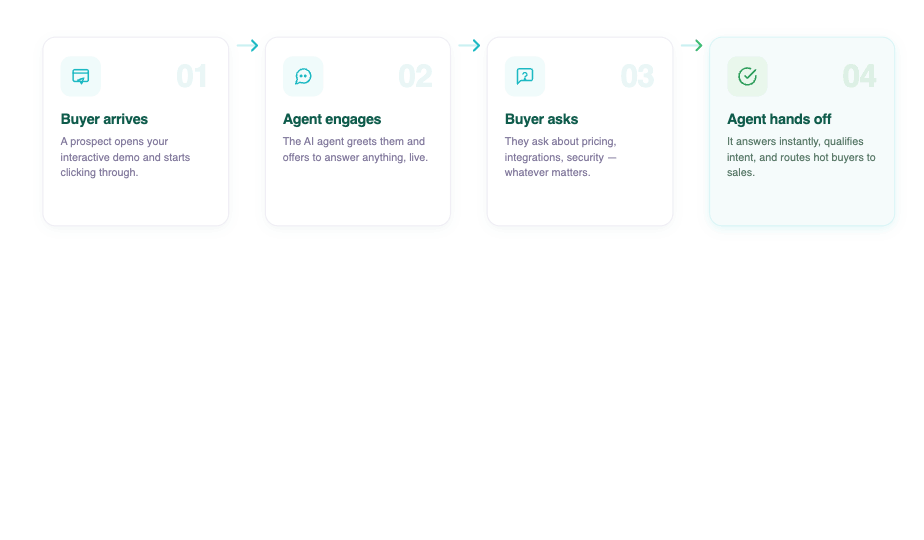
An AI agent embedded in a demo is not a chatbot bolted onto a product page. It is a rep that lives inside the experience — one that understands what the buyer is looking at, what the product can do, and what questions buyers most commonly need answered before they are ready to talk to a human.
The agent changes the interactive demo’s impact on the buyer’s journey across four dimensions.
It responds in context. When a buyer is on the integration screen and asks “does this connect with HubSpot?”, the agent knows which screen they are on and answers accordingly. It is not a generic FAQ. It is a contextually aware conversation grounded in the actual demo content and the product knowledge the seller has provided.
It answers the commercial questions. Integration, pricing, packaging, security, compliance — the questions that most often stop a self-directed buyer from moving forward are not product questions. They are commercial and technical questions that require information beyond what any single demo flow can show. An agent with access to a curated knowledge base can answer these accurately and immediately.
It qualifies. A buyer who asks about pricing for 200 seats, asks about Salesforce integration, and then asks about SOC 2 compliance is showing specific, high-quality intent signals. A static demo captures none of this. An agent captures all of it — and routes the intelligence to the seller in real time.
It hands off cleanly. When a buyer is ready to talk to a human — whether they ask directly or trigger an escalation point — the agent captures the contact, delivers a transcript and summary to the rep, and triggers whatever action the seller has configured: a meeting booking link, an email, a direct route to the deal owner.
The result is a buyer who arrives at the first human conversation already partly qualified, with the rep already knowing what they cared about.
Why the Timing of the Answer Matters as Much as the Answer Itself
There is a principle in sales that the best time to answer a buyer’s question is the moment they ask it. That sounds obvious. But in most B2B selling motions, the answer to a question asked during a self-serve demo does not arrive for 24 to 48 hours — if it arrives at all.
By the time a rep follows up, the buyer is in a different mental state. They have moved on to other vendors, other priorities, other questions. The sense of curiosity that made them ask the question in the first place has dissipated. The moment of highest intent has passed.
An agent answers in the moment. Not because speed is inherently better than substance, but because the question was asked in a specific context — this screen, this feature, this use case — and the most valuable answer is one that acknowledges that context while the buyer is still inside it.
This is why demo completion rates improve when an agent is present. Buyers who have questions and can get them answered stay in the experience longer. They go deeper. They move from passive viewing to active engagement. And active engagement is what produces qualified leads, not passive viewing.
How Does User Engagement During Demos Affect the Sales Process
Most sales teams measure demo views and demo completions. They track how many prospects clicked the link and how far they got through the flow. What they almost never track is what the prospect wanted to know that the demo could not tell them.
That missing data point is arguably the most valuable signal in the entire funnel. A buyer who watched the demo to completion is expressing general interest. A buyer who watched the demo, had a specific question about your enterprise tier pricing, asked about SSO support, and wanted to know about your implementation timeline is expressing specific, actionable, high-quality intent.
Those two buyers require completely different follow-ups. And without a way to capture what the buyer actually asked, the rep treats them the same: a demo completion, a follow-up email, a Zoom link.
Insights AI surfaces engagement data at a session level — what the buyer clicked on, how long they spent on each section, where they dropped off. An AI agent extends that intelligence to the conversational layer: what they asked, what topics they probed, whether they signaled readiness to talk to a human. The combination tells a rep not just that someone engaged with the demo, but exactly what they were thinking when they did.
User engagement during demos affects the sales process in a way that most teams are still not fully measuring. The teams that instrument this layer — conversational intent on top of click and view data — forecast more accurately and follow up more precisely.
What This Means for How You Build and Deploy Demos
If the job of the demo has shifted from education to validation, and validation requires dialogue, then the way teams build and deploy demos needs to shift too.
A demo built purely for presentation — optimized for a guided path that shows the product’s best features in a predetermined sequence — is not built for validation. A buyer trying to validate does not want to follow your sequence. They want to find the thing they care about and probe it.
This changes the brief for demo creation. The most important thing a demo can do is answer the question the buyer arrives with. That means demos need to be built around buyer questions, not seller feature priorities. It means the knowledge behind the demo — the pricing, the integrations, the use cases, the security posture — needs to be as accessible as the demo screens themselves.
And it means the demo itself needs to be a two-way experience, not a one-way presentation. The era of the demo as a static asset a buyer passively consumes is ending. What replaces it is a demo that knows what the buyer is looking at, can respond to what they want to know, and can route them toward a human conversation when they are ready.
The teams building this experience now will not be waiting for buyers to book a call. The buyers will be coming to them already convinced.
Walnut’s interactive demo platform is built for exactly this shift.
Frequently Asked Questions About AI Agents in B2B Demos
What is an AI agent in a demo?
An AI agent embedded in a demo is a conversational layer that lets buyers ask questions and get answers while exploring the product experience. The agent is grounded in the demo content and a curated knowledge base — covering product capabilities, pricing, integrations, and use cases — so answers are accurate and relevant to what the buyer is looking at, not generic responses pulled from a disconnected FAQ.
Why do buyers leave demos without converting?
Most buyers leave demos not because the product failed to impress them, but because they had a question the demo could not answer. The moment of unanswered intent — “does this integrate with our CRM?” or “what does this cost for our team size?” — is the most common point of drop-off in self-serve buying journeys. When that question goes unanswered, the buyer’s options are to wait for a rep, go research elsewhere, or leave.
How is a demo AI agent different from a website chatbot?
A website chatbot operates at the page level — it responds to general visitor questions with information about the company or product. A demo AI agent operates in context — it knows which screen the buyer is on, what the product is doing in that moment, and what the buyer is most likely trying to understand. The answers are grounded in the demo content and the seller’s knowledge base, not just a help center or FAQ page.
What new technologies in demo platforms are changing how B2B buyers evaluate software?
The most significant shift is the move from static, presenter-led demo experiences to interactive demos that can respond to buyer questions in real time. AI buyer agents embedded in demos represent the newest layer — they enable grounded, contextual conversations inside the product experience itself, without requiring a rep to be present. Combined with engagement analytics that capture what buyers actually asked and where they spent time, these technologies are fundamentally changing how buyer intent is captured and acted on.
Does an AI agent replace the sales rep?
No. The agent handles the self-directed part of the buying journey — the questions buyers want answered before they are ready to talk to a human. When a buyer is ready for a human conversation, the agent routes them to the right rep with a full conversation transcript and summary. The rep enters the call knowing exactly what the buyer cared about. The agent makes the rep’s first conversation more productive, not redundant.
How does a demo AI agent qualify leads?
Qualification happens through the conversation itself. A buyer asking about enterprise pricing, SSO support, and implementation timeline is showing specific intent signals. The agent captures all of this — the questions asked, the topics probed, the escalation point if they asked to talk to a human — and surfaces it to the rep in real time via Slack, email, or CRM. The rep knows what the buyer cared about before the first call.
What does it mean for a demo AI agent to be “grounded”?
A grounded agent draws answers exclusively from a defined set of sources — the demo content and an uploaded knowledge base — rather than generating responses from its general training data. Grounding ensures accuracy. A hallucinating buyer-facing agent that invents pricing, misrepresents integrations, or makes up capabilities is worse than no agent at all. Grounded answers with a graceful fallback (“I don’t have that information — want me to connect you with the team?”) are the standard that enterprise-grade buyer agents must meet.
How do interactive demos impact conversion rates in B2B sales?
Interactive demos consistently outperform passive screen shares and recorded walkthroughs on conversion metrics because buyers engage more deeply when they can control the experience. When an AI agent is added, conversion improves further — buyers who get answers to their specific questions stay in the experience longer, signal higher intent through their questions, and arrive at the first human conversation already partly qualified. The combination of interactive demo engagement data and conversational intent capture gives sales teams a materially better picture of which leads to prioritize.