Key Takeaways
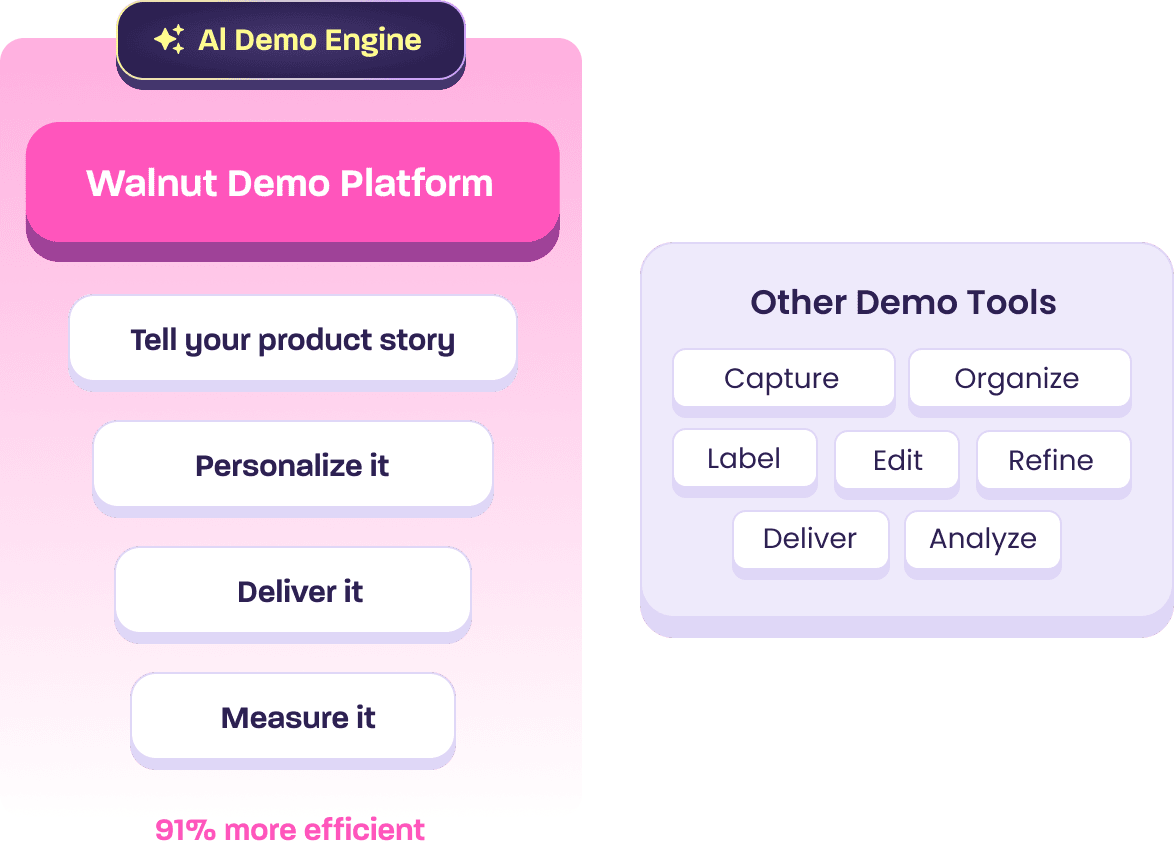
- AI-powered demo creation works in three stages: capture the product once, generate a base demo, then adapt it per persona automatically, replacing days of manual building.
- The highest-converting demos are not the longest or flashiest; they tell a story tailored to one buyer’s specific pain point.
- Focus each demo on three to four workflows that solve a real problem, not a comprehensive feature tour.
- Story Capture learns product flows by watching you use the product, so demos reflect how it actually works instead of generic templates.
- Edits AI adapts messaging for different personas from one foundation, and InsightsAI shows which parts of a demo resonate with each audience.
- Riverbed, Forma, and Darwinbox cut demo creation time by 80% while increasing engagement by 60%, ending the speed-versus-quality trade-off.
The trade-off that just ended
We analyzed over 200 interactive demos created last month, and the results surprised us. The highest-converting demos were not the longest. They were not the flashiest. They were the ones that told a story tailored to each buyer’s specific pain point.
Creating personalized demos at scale used to force sales teams into an impossible choice: speed or quality. You could crank out generic demos fast or spend days customizing each one. AI-powered demo creation ends that trade-off, and this guide explains exactly how it works in a sales process, from capturing your product to measuring what resonates with each persona.
Interactive demos (clickable, self-guided product walkthroughs) are only as good as their relevance to the buyer. The change AI introduces is not that demos look better. It is that personalized, relevant demos stop being expensive to produce. We mapped the wider category shift in What’s New in Product Demo Technology for B2B in 2026.
The personalization problem nobody talks about
Your sales team knows personalization matters. Every buyer wants to see how your product solves their specific problems, not a generic feature tour. But here is what actually happens: AEs spend hours building custom demos for each prospect. They screenshot, edit, script, and hope the messaging landed. By the time they finish, the prospect has moved on or the team is too burned out to keep up.
The teams that try to scale default to one-size-fits-all demos that feel like they were built for someone else, because they were. That is the tension AI-powered demo creation is built to resolve.
What makes a demo actually convert
After analyzing those 200-plus demos, three things separated the winners from forgettable product tours.
Relevance beats completeness. Buyers do not want to see everything your product does. They want to see it solve the problem keeping them up at night. The best demos showed three to four key workflows that directly addressed the prospect’s pain, and nothing more.
Context drives engagement. Generic feature lists lose attention in seconds. A demo that opens with “here is how companies like yours reduce manual work in contract approvals” makes the buyer lean in.
Speed to value matters more than you think. If prospects cannot see the payoff in the first 30 seconds, they are gone. Top-performing demos reached the “aha” moment immediately. The challenge was always that building demos like this took forever. That is the part AI changes.
How AI-powered demo creation works, step by step
Here is the actual mechanism, stage by stage, so you can see where it fits in a sales process rather than treating it as a black box.
Step 1: Capture the product once
Instead of rebuilding demos from screenshots and memory, the AI captures your live product as you use it. You click through a workflow in your real product, and Walnut‘s StoryCapture learns the navigation, screens, and user journey. This becomes the reusable foundation. When the product updates, you recapture the changed flow in minutes rather than rebuilding from scratch.
Step 2: Generate the base demo
From the captured flow, the platform assembles a guided demo: the sequence of screens, the annotations, and the narrative path a buyer follows. This is the master version, the three-to-four-workflow story that solves a specific problem. The AI does the assembly work that used to consume an AE’s afternoon.
Step 3: Adapt per persona automatically
One base demo is not enough, because an IT buyer, a CFO, and an end user each care about different things. EditsAI adapts the messaging for different personas from that single foundation: it changes the pain points highlighted, adjusts the use cases shown, and modifies the value props emphasized, without rebuilding the demo. One foundation becomes many tailored versions, each created faster than it once took to customize a single slide.
Step 4: Measure and refine
Personalization only pays off if you personalize the right things. InsightsAI shows which parts of each demo resonate with which persona: which features drive engagement, which messaging falls flat, which flows lead to next steps. This is where AI stops being a creation tool and becomes a strategy input. You are not just building faster, you are building on evidence.
That is the full loop: capture, generate, adapt, measure. Each stage removes a manual bottleneck that used to make personalization too slow to sustain. For where this fits in the broader sales motion, see AI in Sales: The Complete 2026 Guide.
Real results from real teams
Riverbed, Forma, and Darwinbox did not just save time. They cut demo creation time by 80% while increasing engagement by 60% (Walnut). Faster and better at once. The speed-versus-quality trade-off did not disappear because teams worked harder. It disappeared because AI removed the friction that made personalization expensive.
That combination is the point. Cutting build time alone would just produce more generic demos. Raising engagement at the same time means the demos are landing, because they are tailored to the buyer instead of averaged across all of them.
Where AI-powered demos fit across the sales funnel
The four-stage loop is not only a top-of-funnel tactic. It changes work at every stage of the deal.
At the top of the funnel, marketing embeds a personalized self-serve demo on the website, in email, and in ads. Because EditsAI can spin up role-specific versions from one foundation, a marketing leader and a technical evaluator each land in a demo that speaks to them, without a separate build for each segment. This is what makes a demo viable as a first touch rather than a reward gated behind a call.
In the middle of the funnel, AEs use the same foundation to tailor a demo to a specific account before a call, swapping in the prospect’s industry, use case, and priorities in minutes. The prep that used to eat an afternoon becomes a quick adaptation, which means more accounts get a genuinely personalized demo instead of a generic one.
Late in the deal, SEs take over for the complex, high-stakes customizations that need human expertise: bespoke data, security-specific flows, integration-heavy scenarios. AI handles the repetitive persona swaps so SE time goes to the work that actually decides enterprise deals. We cover that relief in The SE Team’s Guide to Scaling Demos Without Burning Out.
The through-line is that one captured foundation feeds every stage. You are not rebuilding for each team or each moment; you are adapting a single source, which is why the speed gains compound across the funnel instead of helping only one team.
Common mistakes when adopting AI demo creation
The tooling is straightforward. The adoption mistakes are predictable, and three cause most of the disappointment.
The first is treating AI as a volume machine. Generating more generic demos faster is not the goal and does not convert. The point is personalized relevance at speed, so anchor every demo to a specific persona and pain point, not a bulk output target.
The second is skipping the measurement stage. Teams capture and adapt, then never look at InsightsAI to see what actually resonates. Without that feedback, personalization stays a guess and the demos drift back toward generic. The measure step is what makes the next demo better than the last.
The third is inconsistent foundations. If every rep captures their own slightly different base demo, engagement data across deals stops being comparable and the whole system gets noisy. Standardize the captured foundations first, then let reps adapt from them.
Walnut’s stance on AI in the demo process
AI-powered demo creation accelerates production. It does not replace judgment. The AI captures flows, assembles the base, and adapts messaging, which compresses hours of manual work into minutes. What it does not do is decide which story is worth telling, or why a particular buyer should care. That editorial call still belongs to the human running the deal.
The practical effect is a shift in where people spend time. AEs spend less time in editing tools and more time in conversations. SEs focus on complex customizations that genuinely need human expertise instead of repetitive persona swaps. Prospects get demos that address their actual problems. The AI handles the production; the humans handle the story.
Frequently asked questions
How does AI-powered demo creation work in a sales process?
It works in four stages. First, the AI captures your live product as you click through it, learning the real flows. Second, it assembles a base demo from that capture, sequencing screens and annotations into a guided story. Third, it adapts that base per persona automatically, changing pain points and value props without rebuilding. Fourth, it measures which parts resonate with each persona so you refine on data. The result is a personalized demo in minutes instead of days.
How long does it take to create a personalized demo with AI?
Teams using Walnut’s AI features create persona-specific demos in minutes, compared with the two to three days traditional demo creation typically requires. The AI captures product flows once, then adapts messaging for different audiences without rebuilding from scratch.
Can AI really understand my product well enough to create effective demos?
Yes, because it does not guess. StoryCapture learns by watching you use your actual product, capturing real workflows, navigation patterns, and feature interactions rather than generic templates. The demos reflect how your product actually works, not an approximation of it.
What if my product changes frequently?
That is exactly when AI-powered demo creation is most valuable. Instead of manually rebuilding demos on every update, you recapture the changed flow, and updates that used to take days take minutes.
How do I know which personalization actually works?
Insights AI tracks engagement by buyer persona, showing which features, messaging, and workflows resonate with each audience. You personalize based on data about what drives conversions, not hunches.
Does AI-powered demo creation replace sales engineers?
No. It frees them to focus on complex customizations that genuinely need human expertise. Instead of spending hours on repetitive persona swaps and basic edits, SEs concentrate on high-value work AI cannot replicate.
What is the learning curve for sales teams?
The tools are built for sales teams, not engineers. If you can click through your product, you can use StoryCapture. If you can edit messaging in a doc, you can use EditsAI. The design goal is removing technical barriers, not adding them.
The bottom line
The best sales teams stopped asking whether to personalize demos. They ask how to personalize without sacrificing speed, and AI-powered demo creation answers it: capture the product once, generate a base, adapt per persona, and measure what lands. The demos that convert are the ones that tell a story tailored to each buyer, and now you can build them in minutes instead of days.
Ready to see what personalized demos can do for your pipeline? Start for free with Walnut.
Want to see this in action? Explore how Walnut helps sales teams create interactive demos that buyers actually engage with.