Key takeaways
- The best tools for sales engineers in 2026 cut demo prep time, the single biggest drain on presales capacity.
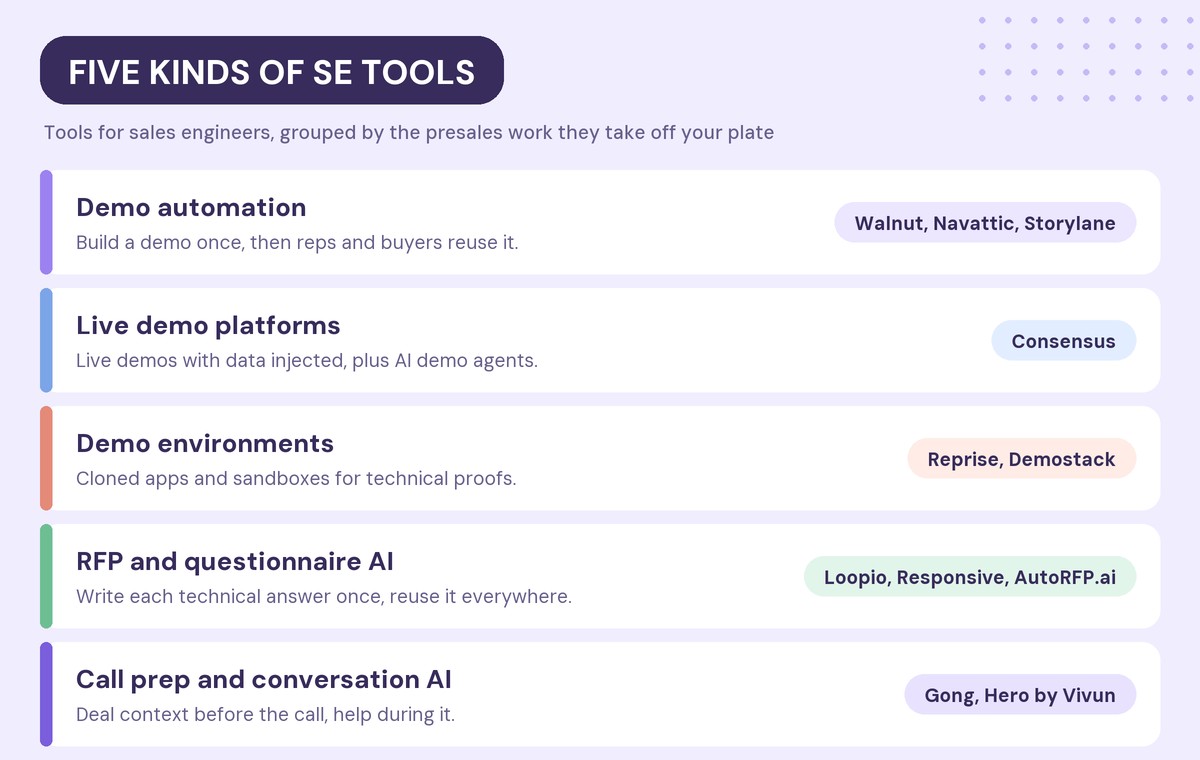
- The 11 tools in this guide fall into five types: demo automation, live demo platforms, demo environments, RFP and security questionnaire AI, and call prep and conversation AI.
- Demo automation lets SEs build a demo once and let reps and buyers reuse it, instead of rebuilding it for every call.
- AI now handles the repetitive parts of presales work, from drafting guided demos and RFP answers to briefing the SE before a call.
- Most presales teams need two or three of these tools working together, not one platform that claims to do everything.
- Choose by where your SEs actually lose hours each week, not by the longest feature list.
Gartner expects 70% of routine sales tasks to be automated by 2030, according to its Future of Sales 2030 research. For sales engineers, the most routine task of all is also the most expensive: rebuilding the same product demo for the fifth prospect this week.
Every hour an SE spends resetting demo data, cloning an environment or answering the same security question is an hour not spent on discovery, technical validation or the deals that need them most. Presales teams rarely lose capacity to hard problems. They lose it to repeat work.
This guide compares 11 tools for sales engineers on what they are best for, what stands out, what they cost and where they fall short. Every tool here targets one goal: giving SEs back the hours that demo prep and repetitive presales work take away.
What do sales engineers need from their tools?
Sales engineers (also called solutions engineers or presales consultants) are the technical experts who prove a product fits a buyer’s needs. Their week splits between work only they can do, such as discovery, architecture conversations and proofs of concept, and work that repeats from deal to deal.
The repeat work is where tools help most:
- Demo prep: building, personalizing and resetting demos for each prospect.
- Environment upkeep: keeping demo accounts stable, populated with realistic data and free of broken states.
- Questionnaires: answering RFPs, security reviews and due diligence questionnaires that ask the same questions in new formats.
- Call prep and follow-up: getting up to speed on a deal, then turning a call into next steps.
A good SE tool removes one of those jobs, or hands it to someone else safely. If you want the bigger picture on capacity, our guide to scaling presales without breaking your team covers the operating side.
How we evaluated these tools
Every product in this list was checked against the vendor’s own product and pricing pages in November 2026. We looked at five things:
- Time saved: how directly the tool removes hours of SE prep work.
- Reuse: whether reps, partners or buyers can use what the SE builds without the SE in the room.
- AI depth: whether AI does real work, such as building a demo or drafting an answer, rather than only suggesting text.
- Fit with the stack: CRM and sales tool integrations.
- Pricing transparency: whether pricing is published, and how it is structured.
We only list a price when the vendor publishes it. Where a vendor does not, we say how they price instead.
Tools for sales engineers at a glance
| Tool | Best for | Standout | Starting price |
|---|---|---|---|
| Walnut | Building a demo once for everyone to reuse | AI Mode and Story Capture | $575/mo, billed annually |
| Consensus | Live demos and AI demo agents | Live data injection (Saleo) | |
| Navattic | Supporting marketing-led demos | Navattic Agents | Free plan |
| Storylane | Small teams wanting published pricing | Free-to-enterprise ladder | Free plan; from $50/mo |
| Reprise | Cloned demo environments | Full application cloning | |
| Demostack | Sandboxes and proofs of concept | Cloner and prospect sandboxes | |
| Loopio | RFP teams that SEs feed | Shared answer library with AI | Custom quote |
| Responsive | Enterprise RFP and security reviews | Trust Center | From $10,000 (Emerging) |
| AutoRFP.ai | AI-first questionnaire answers | Source-grounded answers | |
| Gong | Call recording and deal context | Gong Agents | |
| Hero by Vivun | AI help during the live call | Real-time objection help | $20/mo per seller (Individual) |
The 11 best tools for sales engineers in 2026
1. Walnut: best for building a demo once and letting everyone reuse it
Walnut is an interactive demo platform built for B2B sales, presales and marketing teams. SEs capture the product once, then turn that capture into personalized interactive demos (clickable, self-guided product walkthroughs) that reps can send, present live or embed, without a fragile demo environment behind them.
The time savings come from removing the rebuild. Odaseva cut demo prep from 1.5 hours to 3 minutes with Walnut and went from 8 presales engineers demoing to more than 50 sellers who could demo on their own.

Walnut’s AI does the build work. Key features include:
- AI Mode: describe a change in chat and it makes real edits in the demo editor, such as rewriting copy for a persona, creating guides, swapping static text for variables, anonymizing customer data or updating dates so a demo looks current.
- Story Capture: narrate while you click through the product in the Chrome extension, and Walnut turns the recording into a step-by-step guided demo.
- Templates and variables: SEs build one template, and reps personalize the company name, logo and data for each prospect.
- Buyer Xpert: an AI buyer agent inside the demo that answers product questions from approved content only, then sends the rep a briefing.
- Playlists and Deal Rooms: package demos with files and videos, or put them inside a deal room with a mutual action plan.
- Engagement analytics: see which accounts and stakeholders viewed what, with HubSpot and Salesforce integrations.
Pricing: the Ignite plan costs $575 per month, billed annually, and includes AI Mode for demos, Playlists, Deal Rooms and Buyer Xpert.
Trade-off: Walnut demos are captured from your product’s front end, not a live back end. For deep technical proofs of concept that need real computation, SEs still use a live environment.
2. Consensus: best for presales teams that run live demos and AI agents
Consensus is a demo platform aimed at presales and sales teams. In 2026 it acquired Saleo, a live demo platform, and now covers interactive tours, video demos, live demos and AI demo agents.
- Live demos in your real product, with personalized data injected during the session instead of a dummy account.
- AI demo agents that hold a conversation with a buyer, walk through the product and qualify them.
- Demo Intelligence (Demolytics), which turns demo activity into stakeholder insights.
- Interactive product tours and on-demand video demos.
Consensus says Salesforce cut demo prep time by 92% with its live demo platform.
Pricing: per user license, plus optional usage-based capabilities.
Trade-off: the platform is broad, and teams that only need interactive demos may pay for capabilities they will not use.
3. Navattic: best for SEs supporting a marketing-led demo program
Navattic is an interactive demo platform popular with product marketing teams that run demos on their website, which can take early-stage “just show me the product” requests off the SE team.
- AI demo generation and editing through its Copilot.
- Navattic Agents, conversational agents that guide prospects, answer questions and show workflows.
- Account identification and buying circle discovery on paid plans.
- Salesforce and Marketo integrations, with Gong, Salesloft and Outreach on Growth.
Pricing: a free Starter plan includes one seat.
Trade-off: Navattic’s center of gravity is website and marketing demos rather than the late-stage, deal-specific demos SEs build.
4. Storylane: best for small teams that want published pricing
Storylane is an interactive demo platform with a clear free-to-enterprise pricing ladder, which makes it easy for a small presales team to start.
- Interactive demos with an Ask AI layer on paid plans.
- Hubs for grouping demos and content for a buyer, on Premium and Enterprise.
- Account Reveal for identifying visiting companies, plus Deal Intelligence on Growth.
- Custom domains, SSO and SOC 2 on higher tiers.
Pricing: a free plan is available. Starter costs $50 per month, Growth $625 per month and Premium $1,500 per month, with lower rates for yearly billing.
Trade-off: features that matter to sales teams, such as Hubs and Deal Intelligence, sit on the higher tiers.
5. Reprise: best for cloned demo environments
Reprise focuses on demo environments. It clones your application so SEs can run fully interactive demos without the risk of breaking production or a shared demo account.
- Full application cloning for interactive sandboxes.
- AI data injection that fills demos with realistic data, in cloned or live environments.
- Unlimited no-code guided demos.
- SOC 2 Type II and ISO 27001, with SSO and role-based access.
Pricing: a single annual platform fee with per-user licenses.
Trade-off: cloning a full application is more setup than capturing a front-end demo, so expect a longer implementation.
6. Demostack: best for SE-built sandboxes and proofs of concept
Demostack positions itself around SE work specifically, with the goal of ending manual environment upkeep. It builds replicas of your product that sellers and prospects can use.
- A Cloner that turns a demo flow you click through into a reusable replica.
- Prospect sandboxes, which Demostack customers use in place of some proofs of concept.
- AI tools for bulk data edits and changing application states in plain language.
- AI Agents, which Demostack says are now live.
Trade-off: by Demostack’s own description, it sits at the premium end of the market.
7. Loopio: best for RFP teams that SEs feed
Loopio is an RFP response platform. SEs often answer the technical sections of RFPs, and a shared answer library means they write each answer once.
- A searchable content library with unlimited projects and entries.
- Generative AI included in every plan.
- Security questionnaire support.
- Integrations with Salesforce and Highspot, plus an MCP connection to AI assistants such as Claude and ChatGPT.
Pricing: custom quotes on all three plans (Foundations, Enhanced and Enterprise). Foundations includes 10 seats.
Trade-off: Loopio is built for proposal teams. SEs benefit most when a proposal manager owns the library.
8. Responsive: best for enterprise RFP and security review programs
Responsive covers RFPs, security questionnaires and due diligence at enterprise scale.
- An AI and automation studio from the entry edition.
- A Trust Center for sharing prefilled security questionnaires and documents with prospects.
- LookUp, which gives frontline teams on-demand access to approved answers.
- Intake requests on Growth and above.
Pricing: the Emerging Edition starts from $10,000. Growth and Enterprise require a quote.
Trade-off: Responsive is a large platform with an enterprise price point, more than a small presales team needs.
9. AutoRFP.ai: best for AI-first questionnaire answers
AutoRFP.ai describes itself as an AI-native, source-grounded platform for RFPs, security questionnaires and due diligence questionnaires (DDQs).
- AI answers grounded in your approved sources.
- Support for RFPs, security questionnaires and DDQs in one workspace.
- An API and MCP server that give AI agents access to approved workspace knowledge.
Trade-off: AutoRFP.ai is narrowly focused on questionnaires and RFPs, so it does not help with demo prep itself.
10. Gong: best for call recording and deal context
Gong is a revenue intelligence platform. For SEs, it means walking into a call already knowing what was said in the last three.
- Automatic capture of customer interactions.
- Gong Agents for pipeline review, coaching and deal risk, plus custom agents built in plain English.
- Gong Forecast, which surfaces deal risk early.
- A two-way Salesforce integration.
Pricing: per user license, plus a platform fee based on the number of users.
Trade-off: Gong is usually bought for the whole revenue team. Few presales teams buy it on their own.
11. Hero by Vivun: best for AI help during the live call
Vivun’s product is Hero, an AI sales teammate built to help sellers during live calls.
- Pre-call prep for each meeting.
- Private, real-time help with objections and product questions during the call.
- Follow-up emails and CRM updates after the call.
- An enterprise option where Hero joins as a teammate to run a custom demo.
Pricing: Individual costs $20 per month per seller and Team costs $40 per month per seller (for teams of 25 or fewer), each free for the first 28 days. Enterprise pricing is custom.
Trade-off: Hero is aimed at the seller in the call. It helps SEs prep and answer, but it does not build or host demos.
How do sales engineers reduce demo prep time?
Sales engineers cut demo prep time by building reusable assets once and letting the rest of the team use them. The biggest savings come from replacing per-call demo builds with templates that reps can personalize themselves.
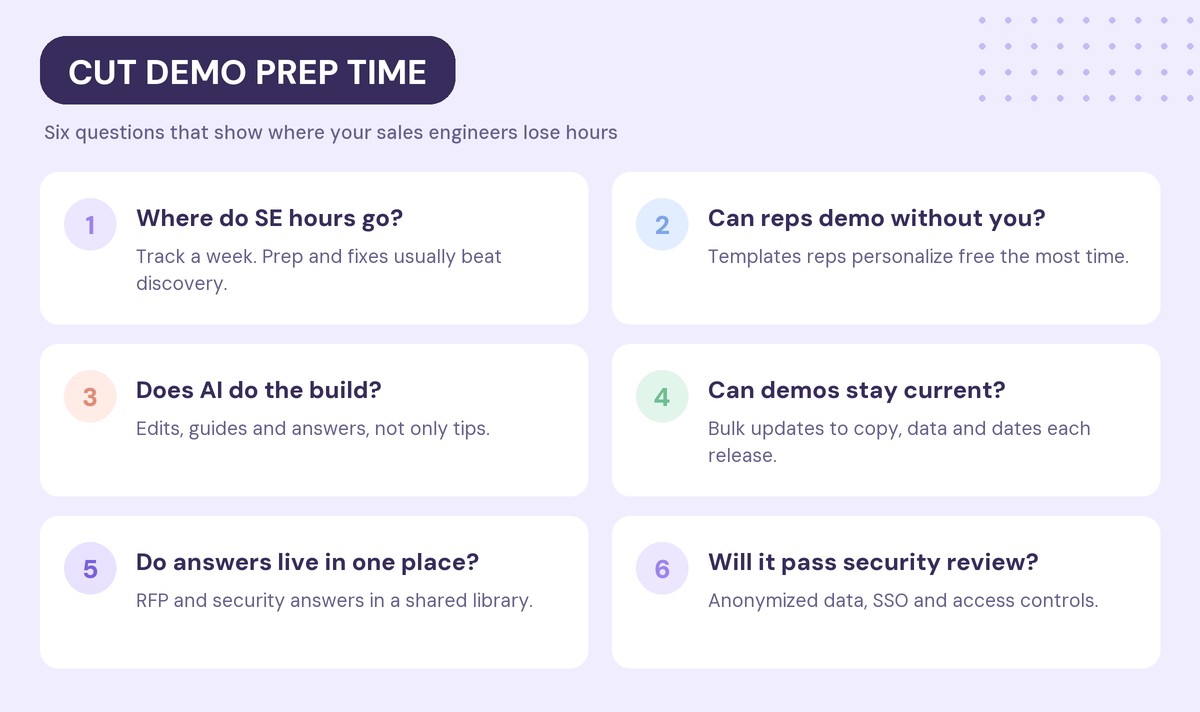
Six questions show where your hours go:
- Where do your SE hours actually go? Track a typical week. Most teams find demo prep and environment fixes outrank discovery.
- Can reps run early demos without you? If every first demo needs an SE, a template that reps personalize frees the most time. We make the case in SEs should author once, everyone else reuses.
- Does AI do the build, or only suggest? Look for AI that edits the demo, drafts the guide or writes the answer, not a chat box that only gives tips.
- Can you keep demos current without recapturing? Product changes break demos. Tools that update copy, data and dates in bulk save hours each release.
- Do answers live in one place? RFP and security answers belong in a shared library, not in an SE’s inbox.
- Will it pass your security review? Demos often show customer-like data, so check anonymization, SSO and access controls. Our guide to demo approval workflows covers governance for large teams.
What does a sales engineering tool stack cost?
Most presales teams combine two or three of these tools, and pricing models vary widely:
- Free entry plans: Navattic and Storylane offer free plans, which work for testing interactive demos.
- Published per-seat pricing: Hero by Vivun publishes per-seller prices for individuals and small teams.
- Published team plans: Walnut and Storylane publish monthly plan prices.
- Quote-based: Consensus, Reprise, Demostack, Loopio, Gong and Hero Enterprise price through sales. Responsive publishes only its entry price.
Compare tools against the SE hours they return. A tool that gives each SE back five hours a week usually pays for itself quickly, while one that adds setup and maintenance can cost more time than it saves.
Interactive demos vs. demo environments: which do SEs need?
Interactive demos and demo environments solve different problems. An interactive demo is a captured, front-end copy of your product that anyone can send or present, which is ideal for early-stage and leave-behind demos. A demo environment or clone runs real product logic, which matters for deep technical evaluations and proofs of concept.
Most SE teams use both: interactive demos for the many repeatable demos, and a live environment for the few deals that need hands-on validation. For a broader comparison of demo platforms, see our guide to the top interactive demo tools.
Frequently asked questions
What tools do sales engineers use?
Sales engineers typically use a demo platform to build and share product demos, a demo environment for technical proofs of concept, an RFP or questionnaire tool for technical answers, and a conversation intelligence tool for call context. Popular choices include Walnut, Consensus, Reprise, Loopio and Gong.
How can sales engineers reduce demo prep time?
Sales engineers reduce demo prep time by building a demo template once and letting reps personalize it for each prospect. AI tools that edit demos, update data and generate guided walkthroughs from a recording cut prep further.
What is demo automation software?
Demo automation software lets teams capture a product and turn it into reusable, personalized demos that can be sent, embedded or presented live. It replaces rebuilding a demo for every call and lets people outside the SE team run demos on their own.
Can AI build a product demo?
Yes. Several demo platforms now use AI to generate guided demos from a screen recording, rewrite demo copy for a persona, anonymize data and update a demo when the product changes. A sales engineer still decides which story the demo should tell.
What is the difference between an interactive demo and a demo environment?
An interactive demo is a captured copy of a product’s front end that buyers or reps can click through without a live back end. A demo environment is a working instance or clone of the product, used when a buyer needs to test real functionality.
Do sales engineers need an RFP tool?
If your team answers more than a few RFPs or security questionnaires a month, yes. A shared answer library with AI drafting means SEs write each technical answer once instead of answering the same question in every questionnaire.
Ready to give your sales engineers their week back? Start for free with Walnut.