Key takeaways
- Interactive demo software pricing in 2026 ranges from free single-seat plans to custom enterprise contracts, and the published paid plans in this guide run from about $35 to $1,799 per month.
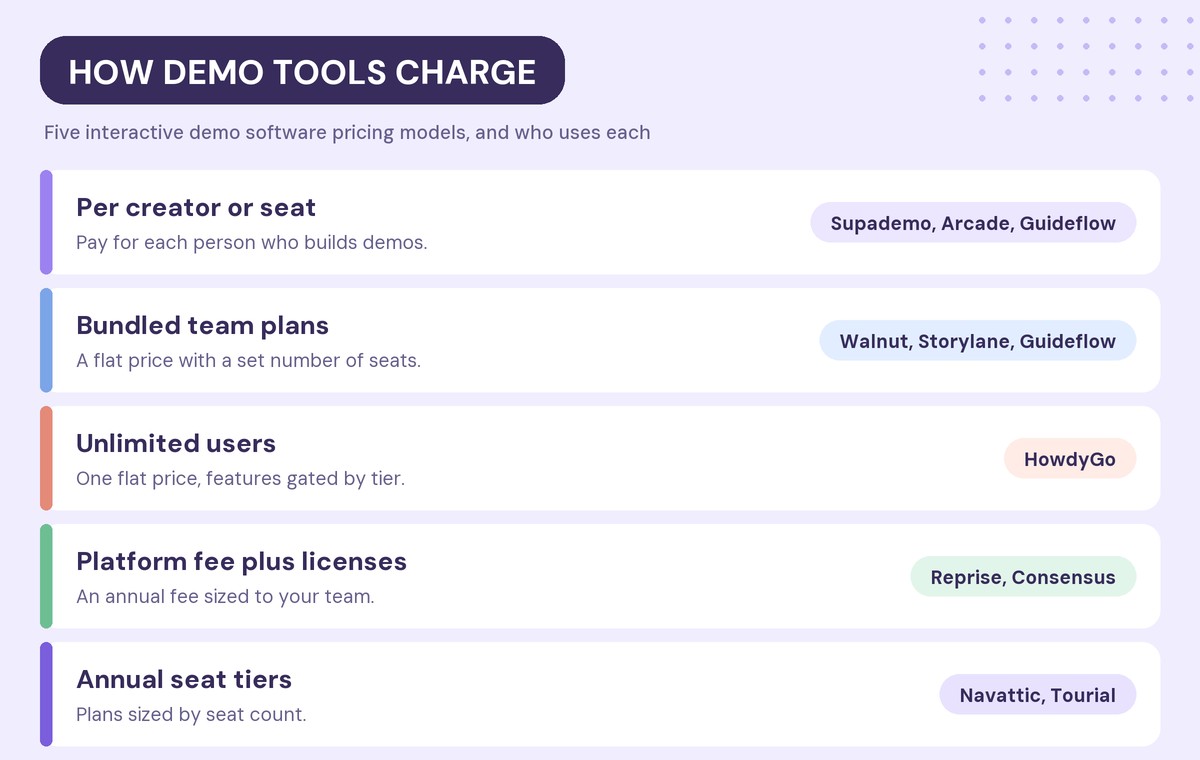
- Vendors use five pricing models: per creator or seat, bundled team plans, unlimited users, platform fee plus licenses, and annual seat tiers with unpublished prices.
- The entry price rarely matches the real cost. CRM sync, SSO, custom domains and buyer hubs often sit one or two tiers higher.
- AI credits are the newest hidden cost. Several vendors meter AI features, so check what happens when the allowance runs out.
- Estimate cost for the plan you would actually need, at your real seat count and billing term, not for the cheapest plan on the page.
Interactive demo vendors price in ways that are hard to compare. One charges per creator, another bundles five seats, a third offers unlimited users, and a fourth sells an annual platform fee plus licenses. The plan that looks cheapest often lacks the CRM sync or security your team needs, which pushes you two tiers up.
This guide compares interactive demo software pricing for 11 vendors, using only prices published on each vendor’s own pricing page in November 2026. It explains how each pricing model works, which features vendors gate behind higher tiers, where the hidden costs are, and how to estimate a realistic budget for your team.
How much does interactive demo software cost?
Interactive demo software (tools for building clickable, self-guided product walkthroughs) costs anywhere from $0 to well over $1,000 per month. Free plans exist for testing, entry paid plans start around $35 to $50 per user per month, team plans run from roughly $159 to $1,800 per month, and enterprise plans are priced by quote.
Where a vendor falls in that range depends less on the tool and more on the pricing model. A per-seat tool can be cheap for one marketer and expensive for a 20-person sales team. A flat team plan can look expensive at first and be the cheapest option once more people need access.
Interactive demo software pricing at a glance
| Vendor | Pricing model | Free plan | Lowest paid plan |
|---|---|---|---|
| Walnut | Bundled team plan, billed annually | $575/mo (Ignite, 3 editor seats) | |
| Storylane | Per seat and bundled team plans | Yes | $50/mo, or $40/mo yearly |
| Navattic | Annual seat tiers (5 and 10 seats) | Yes | |
| Supademo | Per creator and bundled team plans | Yes | $50/creator/mo, or $38 annually |
| HowdyGo | Unlimited users | $199/mo, or $159/mo annually | |
| Arcade | Per seat | Yes | $50/seat/mo, or $42.50 yearly |
| Guideflow | Per member and bundled team plans | Yes | $40/mo, or $35/mo yearly |
| Reprise | Annual platform fee plus per-user licenses | ||
| Consensus | Per-user licenses plus optional usage | ||
| Demostack | Enterprise plans | ||
| Tourial | Seat-capped plans (5 seats or uncapped) |
Prices in the table are the starting price of each vendor’s lowest paid plan, as listed on the vendor’s own pricing page in November 2026. Where a vendor shows both monthly and yearly rates, both are given.
The five pricing models, explained
Per creator or per seat
You pay for each person who builds demos. Supademo’s Scale plan, Arcade’s Growth plan and Guideflow’s Solo plan work this way. It is the cheapest model for one or two builders and gets expensive fast as more people need edit access.
Bundled team plans
A flat monthly price includes a set number of seats, with extra seats sold on top. Walnut, Storylane’s Growth and Premium plans, Supademo’s Business and Growth plans, and Guideflow’s 10-member plan use this model. It costs more at the start and less per person once the team grows.
Unlimited users
HowdyGo charges a flat price with unlimited users on every plan, and gates features and AI usage instead of seats. This suits teams where many people need to edit demos occasionally.
Platform fee plus licenses
Reprise charges a single annual platform fee plus per-user licenses, and Consensus prices by per-user licenses plus optional usage-based capabilities. The price depends on the package you put together.
Annual seat tiers
Navattic sells Base (five seats) and Growth (ten seats) plans billed annually, and Tourial sells an Engage plan with five seats and a Scale plan with uncapped seats. Both are sized by seat count.
What each vendor charges
1. Walnut
Walnut sells three plans, all billed annually:
- Ignite: $575 per month, with 3 editor seats, 3 presenter seats and 50,000 AI credits per year. Includes HubSpot and Salesforce sync, Playlists, Deal Rooms and Buyer Xpert.
- Accelerate: $1,550 per month, with 6 editor seats, 6 presenter seats and 100,000 AI credits per year. Adds advanced analytics, InsightsAI, the advanced Salesforce integration and AI Mode for Playlists.
- Scale: custom price, with custom seats and 200,000 AI credits per year.

Walnut’s AI features run on annual credits. When a workspace reaches 100% of its credits, AI pauses rather than billing overages, and Walnut sends notices at 75%, 90% and 95%. Top-up packs start at 50,000 credits for $1,000. Additional seats, white labelling, sandbox demos and offline demos are add-ons.
What it means for your budget: CRM sync starts on the entry plan, so a team that needs Salesforce data does not have to jump tiers to get it. The trade-off is that every plan is billed annually.
2. Storylane
Storylane shows both monthly and yearly prices, with a 20% discount for yearly billing:
- Free: $0, one seat, basic analytics.
- Starter: $50 per month, or $40 per month yearly, for one seat, plus $40 per additional seat. Includes the HubSpot integration.
- Growth: $625 per month, or $500 per month yearly, for five seats, plus $100 per additional seat.
- Premium: $1,500 per month, or $1,200 per month yearly, for ten seats. Adds the Salesforce integration, SSO, a white-label demo URL and Hubs.
- Enterprise: custom.
What it means for your budget: Salesforce, SSO and Hubs all start on Premium. A team that needs any of them pays at least $1,200 per month.
3. Navattic
Navattic offers a free Starter plan with one seat and one demo. Its Base plan (five seats) and Growth plan (ten seats) are billed annually, and Enterprise is custom. Base adds Salesforce and Marketo integrations, account identification and A/B testing. Growth adds sales integrations such as Gong, Salesloft and Outreach, email and Slack alerts, and buying circle discovery. Navattic Agents, its conversational agents, are priced by the number of conversations and agents.
What it means for your budget: paid plans are annual and sized by seats, and the free plan is enough to test one demo.
4. Supademo
Supademo publishes every self-serve price:
- Free: one creator.
- Scale: $50 per creator per month, or $38 on annual billing.
- Business: $249 per month, or $199 annually, with one creator included and more at $50 per month each.
- Growth: $450 per month, or $350 annually, with five creators bundled and more at $50 per month each.
- Enterprise: custom, starting at ten creators, and the plan that lists SSO and SAML.
Its AI Demo Agent runs on credits: every workspace starts with 1,500 free credits, and packs start at $99 for 1,400 credits.
What it means for your budget: cheap to start, with SSO reserved for Enterprise.
5. HowdyGo
HowdyGo includes unlimited users and unlimited demos on every plan:
- Starter: $199 per month, or $159 per month billed annually, with one collection and the Howdy AI agent.
- Pro: $499 per month, or $399 per month annually, adding demo analytics, CRM and analytics integrations, a custom domain, password-protected demos and five times the AI usage.
- Enterprise: custom, adding enterprise SSO.
AI usage comes from a monthly allowance of credits that resets each month.
What it means for your budget: the flat price makes cost predictable as your team grows, but CRM integrations and analytics start on Pro.
6. Arcade
Arcade prices its interactive demo plans separately from its AI video plans:
- Free: $0, one user and one published demo.
- Growth: $50 per seat per month, or $42.50 with yearly billing, for up to ten users, adding advanced insights, branching, forms, integrations and custom branding.
- Enterprise: custom, for multiple teams, adding SSO, custom domains, HTML capture and demo collections.
What it means for your budget: per-seat pricing stays low for small teams, while SSO, custom domains and collections need Enterprise.
7. Guideflow
Guideflow shows monthly and yearly prices:
- Free: $0, one member and five demos.
- Solo: $40 per month, or $35 yearly, with one member included and $35 per additional user.
- 10-member plan: $599 per month, or $499 yearly, with ten members included and $50 per additional user. Adds HTML capture, AI personalization and a dedicated CSM.
- Advanced: $1,799 per month, or $1,499 yearly, adding sandbox demos, offline demos and a custom domain.
- Enterprise: custom.
What it means for your budget: a low entry price, with HTML-based demos and custom domains on the higher plans.
8. Reprise
Reprise prices with a single annual platform fee plus per-user licenses, and says SSO and role-based access are included in every package. It also offers a free way to start building.
What it means for your budget: expect an annual contract sized to your team.
9. Consensus
Consensus prices by per-user licenses plus optional usage-based capabilities, and says integrating your tech stack is free.
What it means for your budget: your cost depends on user count and which usage-based features you add.
10. Demostack
Demostack says it does not hide its best features behind add-on pricing, and positions every plan around its enterprise demo infrastructure.
What it means for your budget: this is an enterprise purchase, so plan for a sales-led evaluation.
11. Tourial
Tourial sells two plans. Engage includes AI tour generation, unlimited interactive tours, five seats and three tour centers. Scale adds uncapped seats, unlimited tour centers and a dedicated CSM, with premium SSO as an add-on. Both offer a free trial.
What do vendors gate behind higher tiers?
The features that matter most to B2B sales teams are rarely on the entry plan. These four are worth checking first.
CRM sync. Walnut includes HubSpot and Salesforce sync on its entry plan. Storylane includes HubSpot on Starter and Salesforce on Premium. Navattic adds Salesforce on Base, HowdyGo adds CRM integrations on Pro, and Arcade adds integrations on Growth.
SSO. Storylane includes SSO on Premium. Supademo, HowdyGo and Arcade list it on Enterprise. Tourial sells it as an add-on, and Reprise includes it in every package.
Custom domain and white labelling. Storylane includes a white-label demo URL on Premium, HowdyGo includes a custom domain on Pro, Guideflow on Advanced and Arcade on Enterprise. Walnut sells white labelling as an add-on.
Buyer hubs. Grouping demos into one shareable hub is often a higher-tier feature. Storylane’s Hubs start on Premium, and Arcade’s demo collections are on Enterprise. Walnut includes Playlists on Ignite.
If your team needs one of these, price the tier that includes it, not the entry plan.
The hidden costs to check before you buy
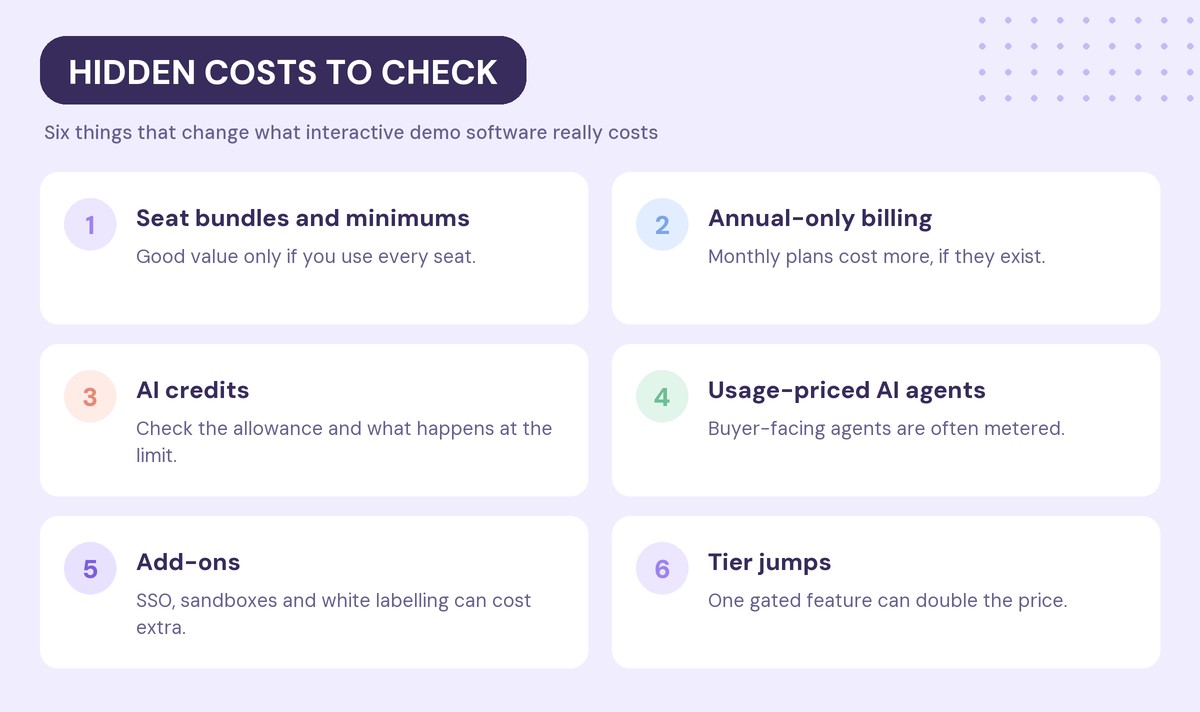
- Seat bundles and minimums. A plan that includes five or ten seats is good value only if you use them. A per-seat plan is good value only until the team grows.
- Annual-only billing. Walnut’s plans and Navattic’s paid plans are billed annually. Where a vendor offers both, the yearly price is about 12% to 24% lower than the monthly one.
- AI credits. Walnut, Supademo and HowdyGo meter AI usage with credits. Ask what happens at the limit: Walnut pauses AI instead of charging overages, and Supademo and Walnut sell top-up packs.
- Usage-priced agents. Buyer-facing AI agents are often priced by usage. Navattic Agents are priced by conversations and agents, Supademo’s AI Demo Agent by credits, and Walnut’s Buyer Xpert is metered per answered conversation.
- Add-ons. Sandboxes, offline demos, white labelling, translations and SSO are add-ons on some plans.
- Tier jumps. The biggest hidden cost is the jump you make when you need one gated feature. Moving from Storylane Growth to Premium for Salesforce adds $700 per month on yearly billing.
How to estimate the cost for your team
Here is a worked example, using only the published prices above and yearly billing where it is offered. The scenario is a B2B team where three people build demos and the team wants CRM sync.
- Walnut Ignite: $575 per month. Three editor seats and HubSpot and Salesforce sync are included.
- Storylane Growth: $500 per month, with five seats and HubSpot. Salesforce needs Premium at $1,200 per month.
- Supademo Scale: 3 creators × $38 = $114 per month. Its pricing page does not list CRM integrations.
- HowdyGo Pro: $399 per month, with unlimited users and CRM integrations.
- Arcade Growth: 3 seats × $42.50 = $127.50 per month, with integrations included.
- Guideflow Solo: $35 + (2 × $35) = $105 per month.
The cheapest number on that list is not the cheapest tool for every team. Once you add the features you need, such as Salesforce sync, SSO or buyer hubs, the order changes. Build your own version of this list with three inputs: how many people will build demos, which integrations and security features are non-negotiable, and whether you can commit to annual billing.
Then weigh the cost against what the tool returns. Our guide to measuring demo ROI shows how to connect demo engagement to pipeline.
Is free interactive demo software good enough?
Free plans are good for testing. Storylane, Navattic, Supademo, Arcade and Guideflow all offer a free plan, but they limit you to one seat and usually one demo or a handful of demos, with limited analytics and branding.
For a single marketer embedding one demo on a website, that can be enough. For a sales team that needs CRM data, multiple builders and personalized demos for each deal, a free plan is a trial, not a solution.
Which pricing model fits your team?
- One or two builders, website demos: per-seat plans from Supademo, Arcade, Guideflow or Storylane Starter keep costs low.
- A growing team where many people edit: HowdyGo’s unlimited users avoid per-seat charges.
- Sales and presales teams that need CRM data and buyer-facing hubs: a team plan that includes those on the entry tier, such as Walnut Ignite, avoids the tier jump.
- Enterprises with security reviews and many product lines: expect a custom contract from any vendor, and compare what is included rather than the list price.
If you are still choosing a tool, our comparison of the top interactive demo tools for 2026 covers features, and our ranked list of the best AI demo creation tools compares how each vendor uses AI. Presales teams can also see our list of the best tools for sales engineers.
Frequently asked questions
How much does interactive demo software cost?
Interactive demo software costs from $0 on free plans to custom enterprise contracts. Published paid plans in 2026 start at about $35 to $50 per user per month for per-seat tools, and team plans run from about $159 to $1,800 per month.
What is the cheapest interactive demo software?
Storylane, Navattic, Supademo, Arcade and Guideflow offer free plans. Among paid plans, Guideflow’s Solo plan at $35 per month yearly and Supademo’s Scale plan at $38 per creator per month on annual billing are among the lowest published prices.
How do enterprise demo platforms price their software?
Enterprise-focused vendors price by package. Reprise charges a single annual platform fee plus per-user licenses, and Consensus prices by per-user licenses plus optional usage-based capabilities, so the total depends on team size and the features you add.
Is interactive demo software priced per user?
Some tools charge per user or creator, such as Supademo Scale and Arcade Growth. Others bundle seats into team plans, such as Walnut and Storylane, and HowdyGo includes unlimited users on every plan.
Do interactive demo tools charge for AI features?
Many do, through credits. Walnut includes an annual AI credit allowance on each plan, HowdyGo includes a monthly allowance, and Supademo sells credits for its AI Demo Agent. Check the allowance and what happens when it runs out.
Which plan do I need for Salesforce integration?
It depends on the vendor. Walnut includes Salesforce sync on its entry Ignite plan, Navattic includes it on Base, and Storylane includes it on Premium. Check the tier before you compare prices.
Ready to see what Walnut costs for your team? Start for free with Walnut.